Commentary
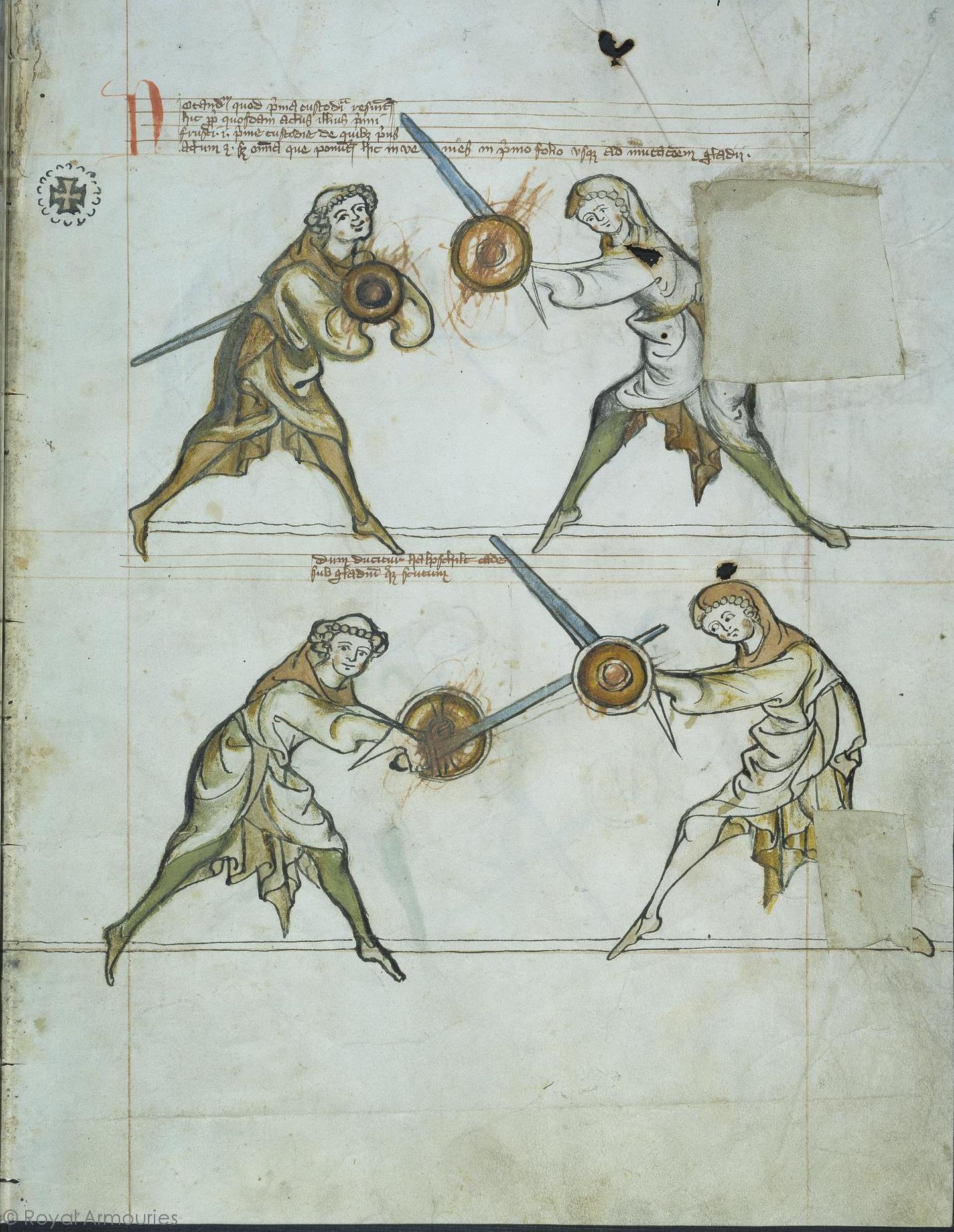
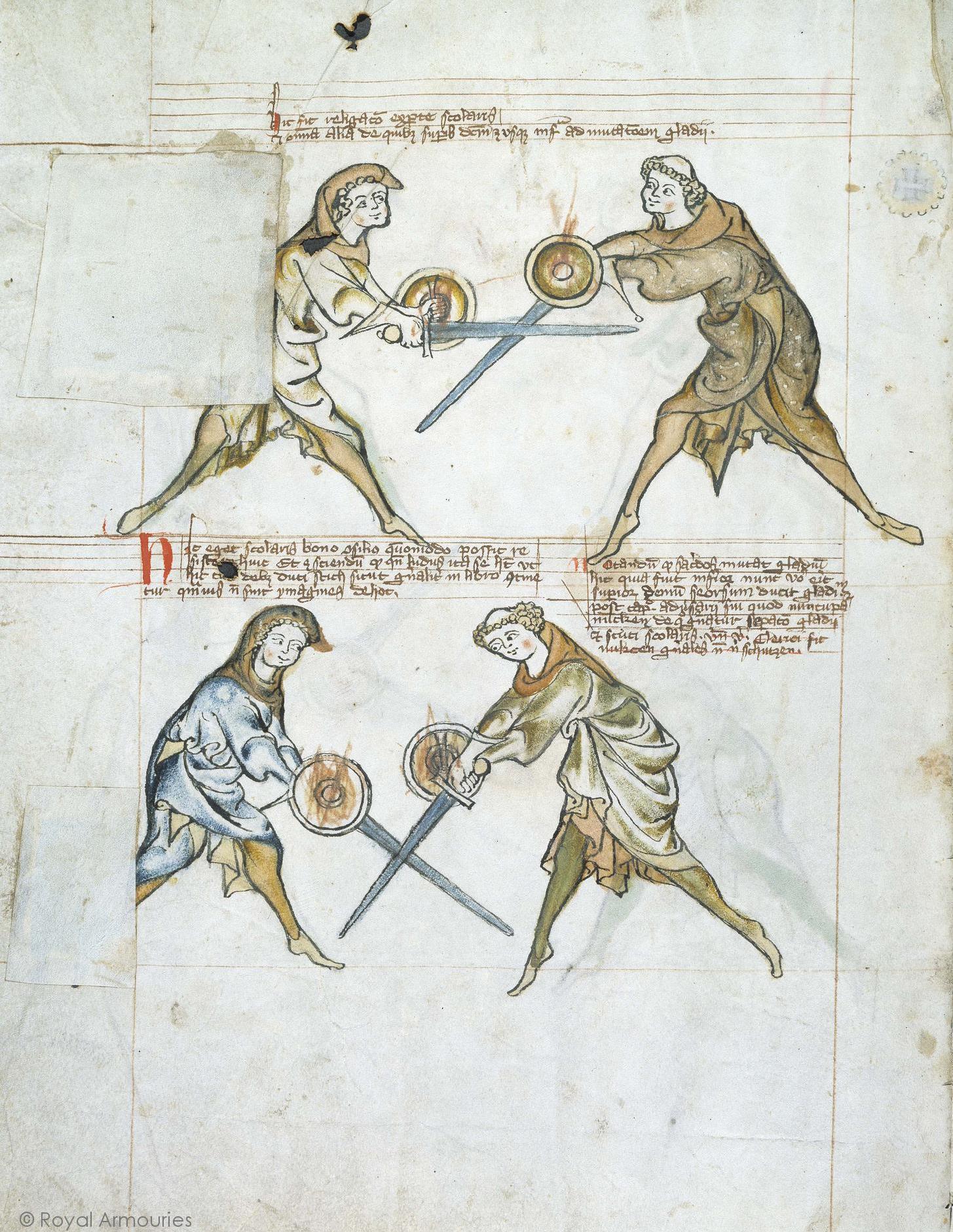
First three images copy what happened in the previous play - the priest fell under, scholar performed a rebind. In this play, it is said that the scholar aims for a stich. His previous rebind and step was a thread of a thrust, and the text says that he should continue into this thrust. This thrust is portrayed in the image in play 29.
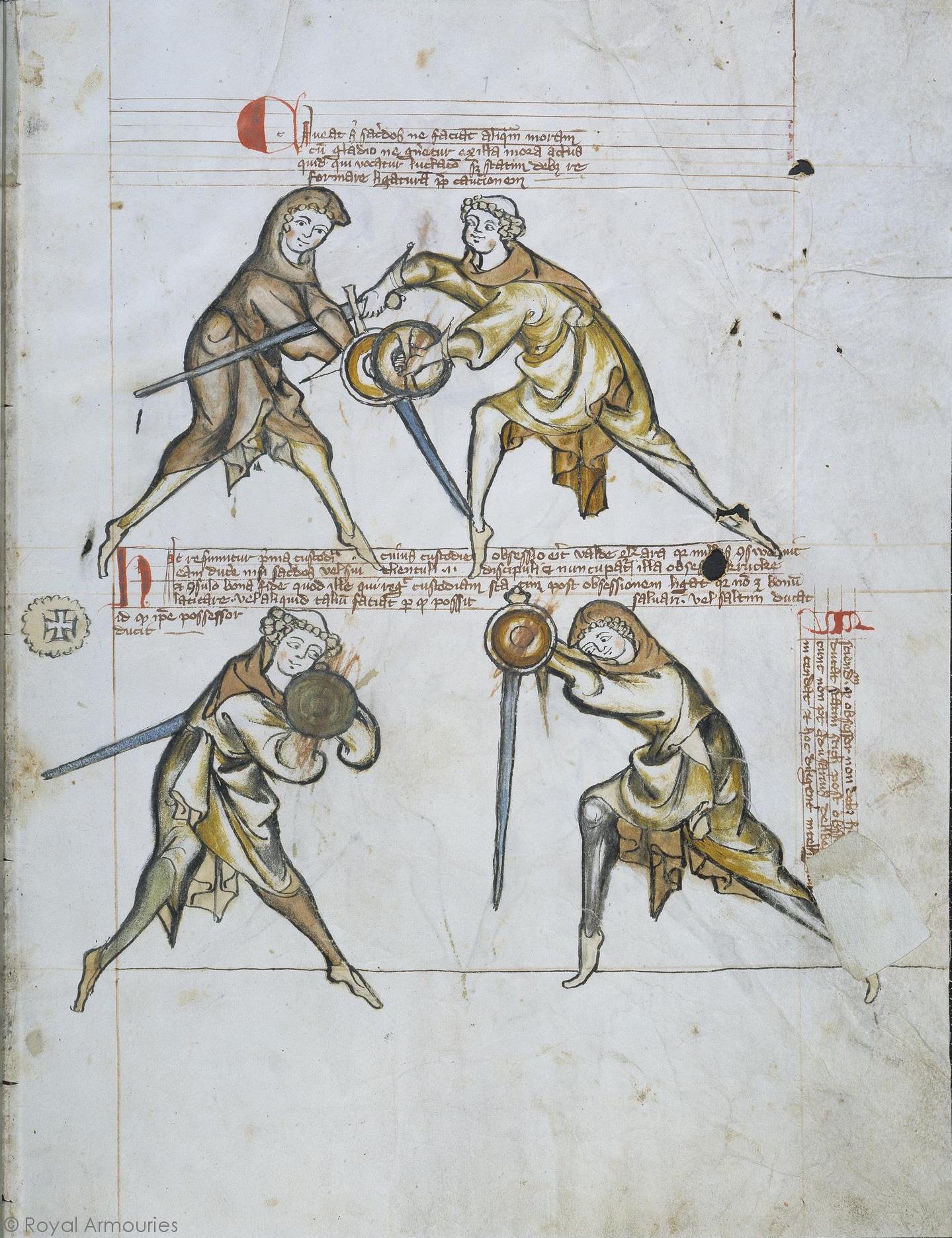
The priest is now forced into binding below and on the left, while scholar binds above and on the right. If scholar is faster, then he would perform a thrust (which s shown in play 29). If the priest react intuitively, thet the scholar would get an opportunity for schiltslack (as shown in previous play). But in this play, the priest is faster and he performs technically superior action - mutatio gladii (which brings him into bind above and on the left), immediatelly followed by nucken aimed between the opponent's sword and shield and in the head.
We are also told (not shown) that common fencers sometimes do schutzen instead of nucken. If the priest would perform this action, he would instead use his sword to carry the opponent's sword down and across to the right side (resulting in a position of low right schutzen). This would result in him binding below and on the right, a situation that should be then solved by stichslack.
The play also advices the scholar how to resist "this" (ie. what to do in reaction to the priest performing his mutatio gladii). The advice is that he should perform a stich - as the priest is finishing his mutatio gladii, he would escape with his blade in the center while thrusting forward, in a cavazione-like motion. The same reaction is shown also in play 23.
The play then finishes by showing us that if the priest doesn't perform his nucken fast enough, his sword could get caught between the arms of the opponent, and he might be disarmed. This may also happen if nucken successfully hits, but the sword isnt removed fast enough. As nucken is probably not a killing blow, the opponent my catch the sword even after he has been hit.
A mistake - in the last image (nucken caught between arms), the sword hand of th epriest is drawn wrong. As this is the right hand, it should either be turned palm up (which should be the case here) or have the thumb on the other side of hand. This is a mistake of illustrators, and it is a mistake even within the graphical style of I.33.