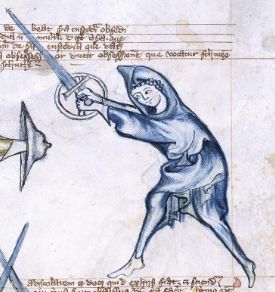
Schutzen is I.33's term for a parry with both shield and sword. So we have multiple schutzen - one for every possible line of attack. Contrary to later medieval fencing systems, I.33 considers a parry to be a technique on its own, different from cuts used in attacking.
Both action and position
To make it even more interesting, schutzen connects an idea of passive protection (a position that covers statically one line of attack) with an idea of active protection (a cut aimed at the opponent's sword). Eg. a passive position that covers right leg with the sword, and a cut aimed at the sword threatening right leg, are considered to be the same thing. Schutzen is thus joining concepts of position and action, which is something that later manuals just don't do. The defining feature of schutzen is its defensive intention.
Any cut aimed at the opponent's sword is schutzen. Any position that intentionally closes one line of attack with the sword is also schutzen.
This is probably based on the fact that if you want to use a static cover provided by a position, you still want to take that position at the last possible moment; otherwise the opponent would switch his strike and attack in a different place. Which means that static parry is usually not that different from a dynamic parry, because you will have to cut in the correct position with correct timing. That blurs the line between a position and an action, and brings the idea to define it based on its defensive intention, instead of its active or passive nature.
Offensive schutzen
I assume the term schutzen (a shelter) to be older one, from unknown fencing systems before I.33. I.33 still uses it, but it also moves its understanding closer to later medieval systems. Any cut aimed at the opponent's sword is schutzen, but a cut towards the opponent's sword can be used also offensively. If you beat away the opponent's sword in order to create an opening that can then be exploited, it would also be considered schutzen by the priest, even though there is no defensive intention behind it. In the same way, I can take a schutzen position to preemptively close the line of attack that the opponent will be using, and step forward into the contact distance. This is clearly an offensive use of schutzen (as a position), but it is still considered to be a schutzen.
Both of these usages will be also considered to be sieges, because they allow me to close in from out of measure. Which is demonstrated in the first schutzen play in the manuscript.
Even though "schutzen" is obviously a defensive term, I.33 does not shy away from using it offensively. Thus foreshadowing future fencing systems, that will altogether stop differentiating between offensive and defensive cuts (and positions).