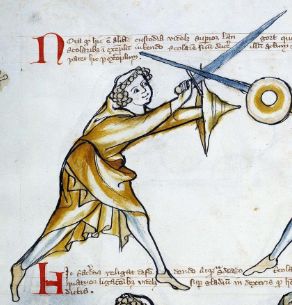
I.33 contains 3 positions called longpoint (langort)
- longpoint (standard one, septima custodia)
- high longpoint
- priest's special longpoint
Longpoints that don't point forward
Only one of logpoints (the standard one) is ever potrayed as pointing the sword towards the opponent, and only when used as obsessio. Even the first model image of longpoint (folio [1v]) shows the sword pointed down. This is quite unusual, because in all medieval fencing systems, langort equivalent is defined by the fact that it threatens the opponent with the tip of the sword. I.33's longpoint can do that too (if used as an obsessio), but longpoints typically don't. Priest's special longpoint even can't be described as "long".
The reason is that in I.33, the defining feature of longpoint is the fact that it can work with the opponent's blade in the bind. This is how we should understand the statement from I.33
omnes actus custodiarum siue gladii determinantur in ea i. finem habent & non in aliis (all actions of the sword are confined within her (langort custodia), ie. they end in her and not in others)
Out of 7 basic guards, only longpoint reaches with the sword forward, which enables it to take the bind with the opponent's sword, feel it or restrain it. This is also what makes longpoint position so important (the most important one of all 7, as I.33 says). Bind is extremely important for I.33.
Longpoint in I.33 is defined by its ability to work in the bind. That's why it doesn't have to point the sword forward and still be longpoint.
Other longpoints are derived from standard longpoint. Any position that you will get into during binding has to be called longpoint, because only longpoints work in the bind. That is why priest's special longpoint is called longpoint even though it is pretty short and even points the tip back. It is used to maintain the bind while closing in for grapple, so it has to be a longpoint.
Longpoint positions are also the only custodiae, that you will be using in the second phase of attack (entering, fight in contact distance). In contact distance no other positions then longpoints should be used, because they are not safe. In this distance you always want to either hit the opponent or control his sword by the bind.
Longpoint that does point forward
Standard longpoint can be used as an obsessio, ie. you can take longpoint position and close the distance. This is the only case where I.33 shows longpoint pointed forward towards the opponent. It is neccessary, because the tip of the sword serves as a threat that keeps the attacker safe while he is closing in. The logic is similar as with common sieges like halpschilt, but here the position itself can serve as a threat.