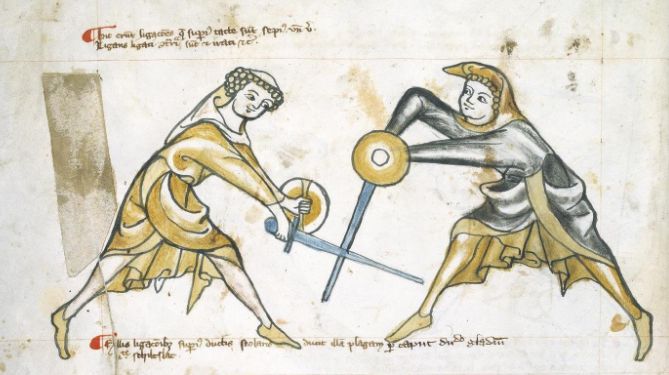
I.33 offers multiple defensive options.
Defence against sieges
General recommendation is "don't defend with the shield only, unles you are constantly retreating." If the shield is used just by itself, the opponent's sword will always be able to circumvent it. In I.33, this is represented by several short plays about omitting the bind - they are showing what will happen to the defender who doesn't use the sword in defence.
Shield is not enough; for successful defence against systematic attack, you have to include the sword somehow.
The priest puts emphasis on including a bind in the defence - either immediatelly (by performing schutzen) or after the shield catches the first blow (as in first play of krucke). If we disregard tricks, a thrust has always to be defended by some kind of a bind.
Another way how to include a sword in defence is in-tempo counterattack. Here the blow itself is defended usually just by the shield, but the sword is used at the same time to threaten the opponent. This doesn't give the opponent time to start circumventing the shield, so it also works as a prevention against it.
Some sieges don't involve a direct strike at the defender (like schutzen or very rare and very good siege ). They are usually defended in contact distance by a bind, or by some kind of trick.
Defence in contact distance
In contact distance, there is not clear distinction between attack and defence. For example stichslack is doing both at the same time. More emphasis here is put on the control in general, than on specific defensive technique against specific offensive technique. Here the most important tool is a bind, that is able to limit or thwart opponent's offensive attempts just by itself.
If you for any reason lose the bind, you use a rebind to gain the control back.