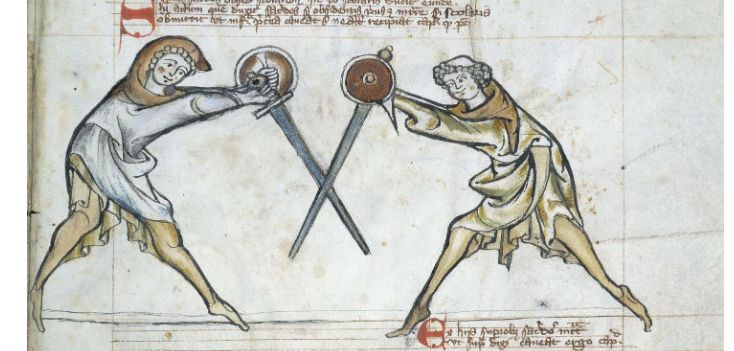
I.33 makes an analogy between 1-on-1 combat and battles of armies; this is the source of some wierd terminology that we see in the manual. It should be said that such analogy is in fact not that unusual, and we can find something similar in the treatise of Johannes Lecküchner.
Phase 1 - besieging
If a fencer wants to attack his opponent, he first has to close the distance, because the combat starts out of measure - in a distance from which they can't reach each other. In order to even have a chance to harm his opponent, the fencer needs to get in the contact distance - a distance from which he can reach the opponent with the sword without making a step.
If an army wants to break in the castle, it first has to get to the castle walls and engage with the defences. It has to bring in battering ram to attack the gate, or ladders to attack walls etc. This process is usually called "besieging", and it is a direct analogy of a fencer who needs to get into the contact distance and engage with the defence of his opponent.
Closing the distance from out of measure is a risky move, because as soon as fencer gets in contact distance, the attacker can hit him, and he will be always faster. That's why the attacker has to employ some technique, that would allow him to close in safely. A typical way how to do that is to attack the defender together with shortening the distance; this attack can be any simple cut or thrust. The idea is that the opponent has to defend, which allows me to close in safely.
Because I.33 sees this first part of an attack as an analogy of besieging the castle, the techiques that allow you to "besiege" your opponent in this way are called sieges (obsessiones, sg. obsessio). The process of closing in the contact distance is again called besieging.
Obsessio is a technique that enables you to safely close in from out of measure. This is may include threatening the opponent with a cut or thrust, but not neccessarilly.
Phase 2 - entering
If the army succesfully besieged the castle, it means that the troops have broken the gate or got on the walls, and they can now directly engage the defenders. So this is a direct combat between the attackers and defenders, where the attackers are trying to break through the defenders and enter the guarded area.
If a fencer has sucessfully besieged his opponent, he is in the contact distance, and his aim is to get the sword behind the opponent's defence. Because if he does, then there is nothing more that would prevent him from hitting the opponent. This fight is mostly (but not neccessarilly) happening in the bind, because the distance is so short, that you want to control the opponent's sword with the bind to be safe. The attacker's aim in this phase is to enter or to invade behind the defence of the defender. Which is, again, an analogy of invading army.
Successful besieging typically means that you now have to fight in the bind for the possibility to overcome the opponent's defence.
Phase 3 - the hit
This is the phase, that I.33 doesn't talk about, because it is simple. Army has broken in the castle, so the troops only have to get to the local lord and execute him. The fencer has his sword unhindered, so he can just hit his opponent in some vital area.
Notes
In my interpretation, this is how the priest views a process of attacking. And it also explains some terminology he is using. Notice that
- All the simple attacks like downwards cut (halpschilt) or rising cut (krucke) are being used in the besieging phase, and they are called sieges. Not every siege has to be a direct attack, but they often are.
- Sieges can be deadly by themselves, so you can win the combat just by besieging the opponent. It would be an analogy of army approaching to the castle, and realizing that the castle gate is open and undefended. It can happen, but I.33 doesn't show it and the priest doesn't expect it to happen.
- What usually happens is that the siege hits the defence of the opponent (eg. his shield). If this happens, then the besieger did not hit the opponent, but he has succesfully closed the distance, and it is considered a successful siege. It means that the fencers entered the second phase.
- It is also possible that the siege missed, because the opponent stepped back. This means that after the first siege, the attacker is still out of measure, and if he still wants to attack, he has to launch another siege. This is what can lead to several cuts being chained one after the other.
- If you sucessfully enter the second phase of attack, you will no longer be using sieges. Those were intended only for the first phase. The tools of the second phase are stichslack, schiltslack, mutatio gladii, nucken etc. Every play of I.33 concentrates mostly on this phase of combat, so we have a lot of information about it.