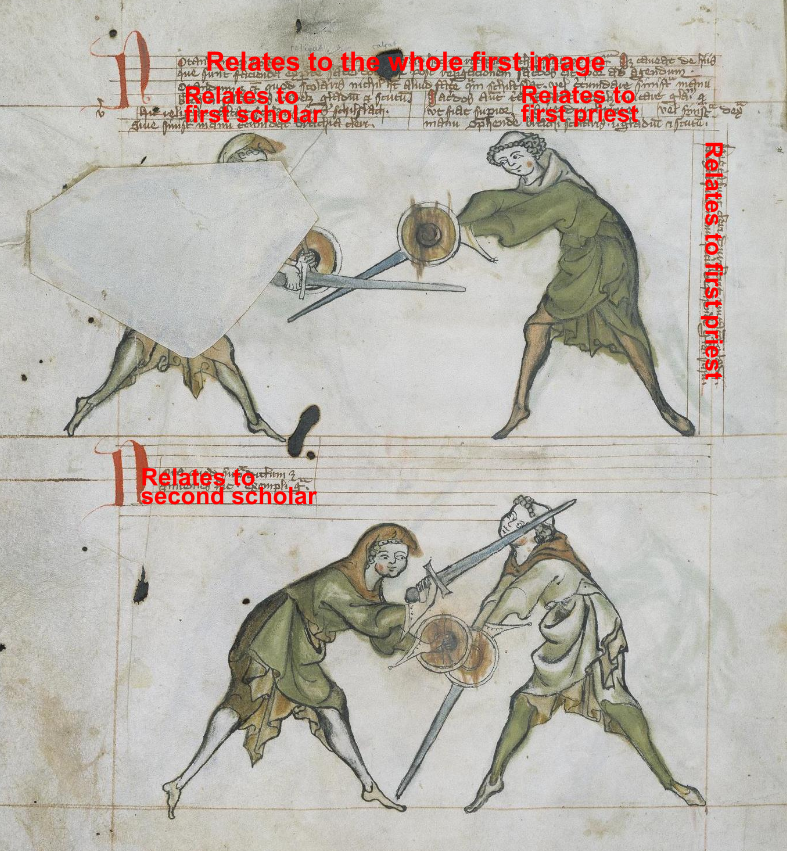
Every page of I.33 contains two images, one above the other. Paragraphs of text are situated above the images, between them, sometimes next to the images rotated 90 degrees, and in one case below the images.
On every page, images are the primary content. Text serves as a description or commentary to the images. Sometimes a commentary to what happened between the images. A text always comments the image that is below it - that's why all of the texts are above images, and never on the bottom of the page - with one exception.
Page [2r] is the only one that contains the text below all images. But this text was probably added later, because it has a different handwriting and it is not written into lines (while all other texts are always written in pre-lined area).
One or two columns
Most paragraphs of text span the whole width of the page. But there are also cases where the width is separated into two columns, so we have two paragraphs side by side. Sometimes, one of the paragraphs is empty.
This layout serves a purpose (a different one then to make the text more readable). A text that spans the whole width of a page, or is shorter but situated at the center, is a general description of the whole situation in the image. But if the text is separated in columns, then the text of each column is talking about the fencer, that is in the image on the same side the column. Thus the text in a column serve as a label or description connected to the corresponding fencer. A text at the side of the image, rotated 90 degrees, works in the same way - it is also connected to the fencer on whose side it is.
An example
The following is a layout of folio [3v].
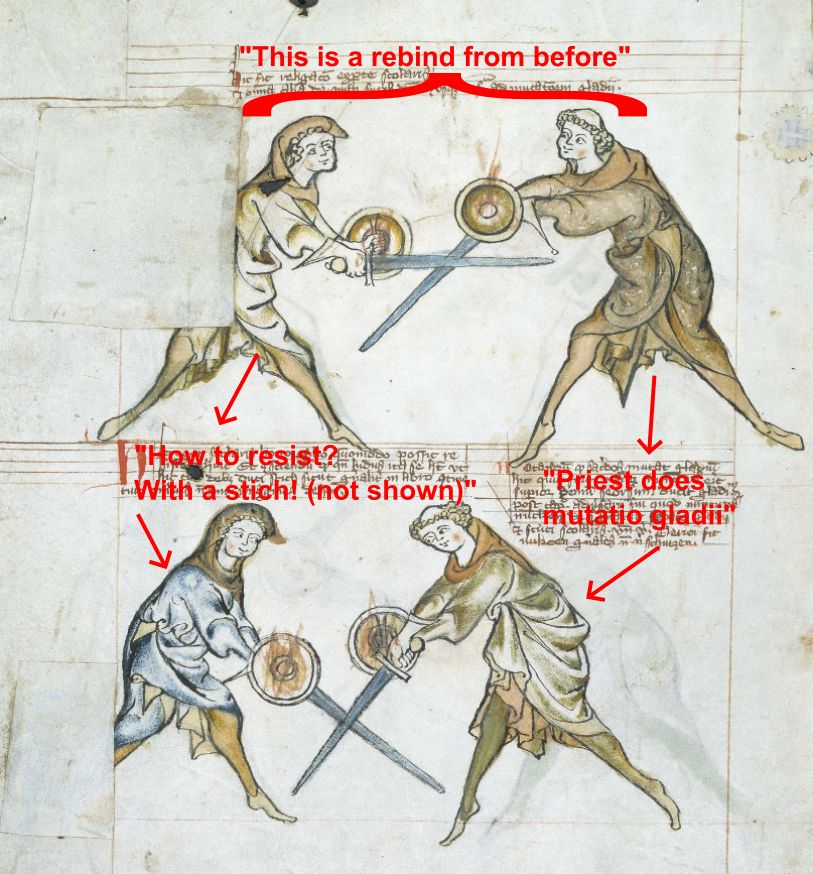
At the top, the full-span text describes what is shown in the first image (a rebind form the scholar). Between the images we have two columns.
Right column relates to the right fencer, who is the priest. It tells us that between the images, the priest is performing mutatio gladii.
Left column relates to the left fencer, who is the scholar. It explains what is the correct way how to defend against priest's action (a stich). The image itself is showing the scholar not counteracting in any way, but the text explains us that a stich would be the correct solution, and that this solution is not shown in the image.