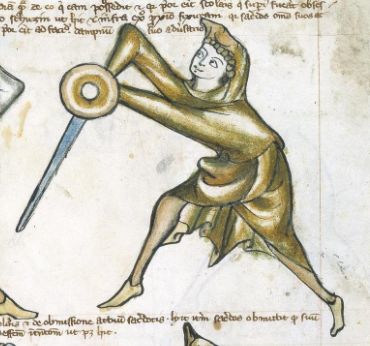
The images of I.33 are famously wierd and deceiving. But that doesn't mean that they are not useful. I believe the images have their inner logic, and even though they often look wierd as a whole, they were in fact drawn according to the rules. If we extract these rules, we will be able to decode any image and understand what real-life situation it was attempting to portray. I am here utilizing the assumption of authors trying to do their best.
Images are portraying real-life situations, and even they might look wierd, they follow rules and are decodable.
What are these rules? I have determined them by examining the images themselves.
Most of the image is realistic
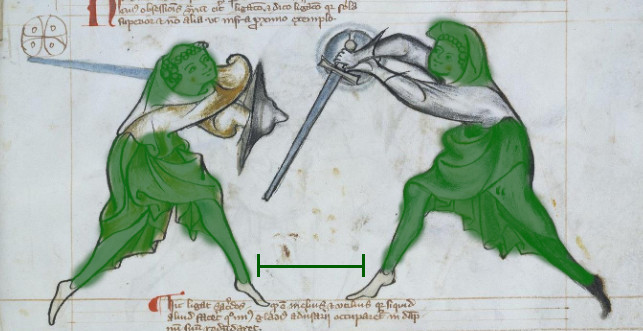
The bodies, legs and heads of fencers are always portrayed realistically from the side point of view, and in fact some care was taken to ensure that they really match the real-life situation. The stance, that we see fencers in, is close to reality. If we see a stance changing a bit between images, we see adjustments that were (mostly) happening also in real life.
Notice that we can't usually decide which leg of the fencer is forward. This is (unexpectedly) caused by too much realism - details of leg position are lost in realistic draped fabric. So the body is even overly realistic, and we would sometimes want more sketchy image to understand it better.
Importantly, also a distance between fencers and reach of their weapons is (mostly) portrayed close to reality. We can see that between images, the distance is sometimes changing as they close in or out.
This image highlights all the directly realistic parts in green
But others unrealistic
The feet of fencers are not realistic at all. Fencers are often portrayed on their tiptoes, which was certainly not a common feat. This is the artists making impression of motion, or maybe showing us that the fencers are moving swiftly and are light on their feet.
The images also have no way to portray motion. Every image is a still. We cannot recognize if the image portrays a static position, or is showing the middle of a fast cut.
Weapons may be portrayed from a different point of view
The most important part of every image is position of weapons, and here the portrayal is tricky. Because the weapons may be portrayed from a different point of view then the rest of the image (which makes for very wierd images), and we have no way to tell based just on the image itself.
- Sword always has to be shown flat in the 2d image. It cannot be tilted in 3D (towards or away from the viewer), only rotated in 2D.
- If the real-life position of weapons could be portrayed from the side (same point of view of bodies are) without making too big adjustments to the tilt angles, they were portrayed in such way. This is the case of eg. a halpschilt cut, where both the sword and shield are almost not tilted towards or away from the viewer.
- If the real-life position cannot be reasonably portrayed in this way, the weapons will be portrayed from topdown view. This means that the plane, in which the weapons are drawn in 2D image, was in reality turned 90 degrees in 3D. This is the case of schutzen position used late in the manual.
- If even topdown view is not suitable, a frontal view can be used. This is the case in the shield of prima custodia.
- Usually both weapons are portrayed from the same point of view. But sometimes it is possible to have the shield portrayed from different point of view then the sword. This is again the case of prima custodia.
These rules determine the plane on which weapons are drawn. Within this plane, there are some more adjustments made
- Sword is placed in correct position and rotation within its plane. But tilt in 3D and rotation of the sword along its long axis are disregarded.
- Shield is alway placed in a correct position, but is never rotated within its plane. On the other hand, its 3D rotation is simulated by the image of the shield - we have a shield facing forward, shield facing back and shield turned sideways.
Hands and arms are misleading
Hands are always copying the position of the sword and shield, as it is drawn. They are portrayed realistically, but only to match the rotation of the sword. Which may be completely unrealistic in its rotation along the long axis. This leads to potrayals of completely unrealistically rotated wrists.
Arms are the tricky part. They are connecting bodies with hands and weapons ... but that means that they might be connecting two different points of view together. That is the reason why arms are sometimes very wierdly distorted. But they also contain a realistic feature - bent or straight elbows. If the elbow was bent in real-life situation, it will also be bent in the image.
Example
It should be noted that the description above describes how the illustrators were creating their images based on real-life situation. But if we are decoding the images, we have to apply the rules in reverse, and for this we sometimes may not have enough information in the image itself. For example it is not possible to determine the point of view for the weapons. So here we have guess, if possible with the help of the text of the play and some analogies to other fencing systems.
Lets analyze the following image.
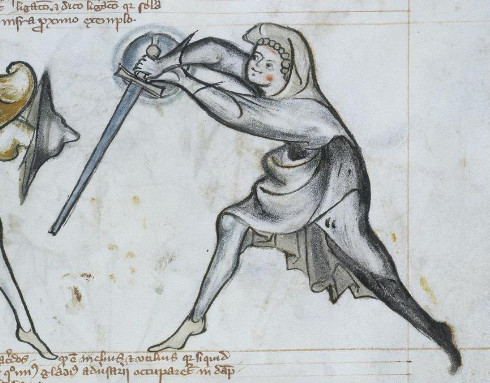
We see the scholar in a classical fencing stance, which is realistic. Except for that most probably he wasn't standing on his tiptoes. The distance from the opponent (partially visible on the left side) is another the realistic feature - whatever the scholar is doing, he can hit the shield of the opponent with a half of his blade.
We don't know if the image represents position or an action. But based on the text, we decide that it should be a cut, so the image shows a middle of action.
Position of his weapons may be either vertical or horizontal. So he is either cutting a rising cut or a horizontal cut from the left, and we can't decide just by the image itself. We have to determine this by other means, or work with both possibilities until it will be possible to desambiguate. We also should accept not only a flat vertical or flat horizontal cuts - some small tilting to diagonal cut might be possible. But whatever interpretation we choose, we can be sure that the sword hand should be above the shield hand, and that the sword is tilted partially forward.
We also don't know if the sword is aiming forward with the edge or with the flat. This rotation (along the long axis) is always portrayed the same. But because we expect that this image represents a cut, we would settle on the edge-forward interpretation. Which means, that the image is in fact realistic in this feature.
So this is our interpretation. Some parts of the image have to be guessed. But the image is also giving us a lot infromation that is firmly determined. For example:
- Sword is tilted forward, not back.
- Both weapons are held together and at the head height
- Sword hand is above the shield hand, not below it.
- Sword arm is slightly bent, shield arm is also not clearly straight.
- Sword is rotated as it should in cutting with true edge. It cannot be portraying a thrust or a cut with false edge.