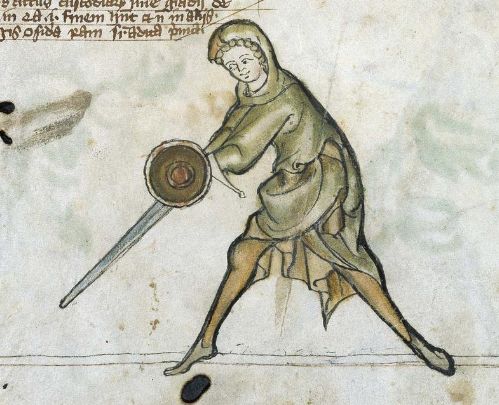
Custodiae (guards, sg. custodia) are "offensive" positions - offensive, because these positions do not close any line of attack with a sword. This differentiates them from schutzen, that are by nature defensive, because they always close some line of attack with the sword. Custodiae can be used for waiting, and they can lauch both offensive and defensive actions.
7 basic guards
I.33 tells us an important information - all fencers, regardless of their training and skills, will make use of 7 basic guards. These are subset of all custodiae, that represent the most natural positions which arise from natural usage of the sword and shield. Whoever swings the sword in any natural way will start and end in one of the 7 basic guards. He will do it intuitively, he doesn't have to even know about it. Such guards thus form the core of a fencing system. In I.33, these guards are identified by numbers.
- Prima custodia
- Secunda custodia
- Tertia custodia
- Quarta custodia
- Quinta custodia
- Sexta custodia
- Septima custodia - longpoint, langort
I.33 divides 7 basic guards into two groups, based on how they handle a threat of opponent's attack. This is hidden in I.33's statement Tres sunt que preeunt relique tunc fugiunt (three go in front, the rest of them flee).
Fleeing guards
These are secunda custodia, tertia custodia, quinta custodia and sexta custodia. All of these guards work in defense in a way similar to a retreating army (this is another case of analogy between 1-on-1 combat and armies that I.33 makes).
All fleeing guards have the shield extended forward to serve as a rearguard of an army. It will be able to defend attacks of the opponent as long, as fencer can retreat back maintaining the distance.
These guards also employ the sword retracted back, ready to deliver some kind of a strike (different guard will deliver different strike). This is an analogy of the rest of the army, that has (covered by rearguard) already retreated to a safe position and regrouped. If the fencer cannot (or doesn't want to) retreat anymore, he would have to use this sword either to take the bind, or to threaten the opponent with in-tempo counterattack. In the same way as the regrouped rest of the army would perform a counterattack to relieve the rearguard if it gets in problems while keeping the enemy occupied.
Active guards
The three remaining guards - prima custodia, quarta custodia and langort - work differently. They don't have shield as a rearguard, so they need to actively intercept any attack that the opponent launches. This is analogy of an army firmly in combat - it doesn't retreat, instead it defends itself by conducting counterattacks or maneuvers. Each of three remaining guards have different tools to achieve this goal - langort for example uses its ability of binding to restrict the opponent's possibilities and lead his attacks away.
Active guards don't have the shield forward, so they have to defend by actively intercepting attacks.
Other custodiae
Later in the manuscript, I.33 introduces a few more custodiae, that I would call additional guards. These are special position used for different purposes - sometimes as an unusual waiting position ready to launch specific tricks, sometimes as a tool to better describe a more complicated situation.
Additional guards are