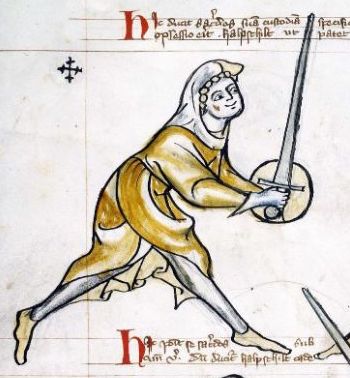
Siege (obsessio) is a technique intended to be used in the first phase of an attack (besieging), and not later. It allows the attacker to safely close the distance from out of measure. The typical sieges (like halpschilt or krucke) are basic cuts, which allow for safely closing in, because they occupy the opponent by the attack. They are dangerous by themselves, but the priest expects them to be blocked, so he is viewing them only as a vehicle that can get you from first phase of attack to the second one.
Every basic obsessio (cut or thrust) always goes from one basic custodia in different basic custodia. This means that basic guards are starting and/or ending points of every simple cut or thrust - thus having the same role as in later medieval fencing systems.
For example halpschilt can cut either from tertia custodia into quinta custodia, or from secunda custodia into prima custodia.
I.33 also uses different non-attack actions as sieges. Schutzen can be used as a siege to preemptively close the line of attack, that attacker will be probably using, thus making it safe to close the distance. This does not directly threaten the opponent; it makes the besieger safe not because it occupies the defender, but because it preemtpively closes the line of attack he will be using.
An obsessio does NOT have to threaten the opponent. It may employ different mechanisms to make you safe while besieging (closing in)
Some guards (custodiae) can also be used used as sieges - which means, that the guard itself has properties, that can make you safe while closing in. For example langort will - while closing in - work as a thrust, and thus an attack that the opponent has to defend. So closing in with langort is similar as closing in with some type of cut, like halpschilt.